Monday, April 13, 2009

M-E-A-N-D-E-R-I-N-G . . .

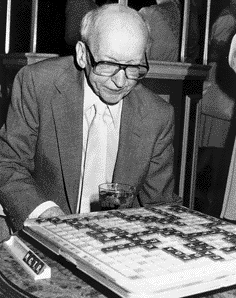
Today is the birthday of Alfred Mosher Butts (April 13, 1899 - April 4, 1993), architect, artist and inventor, best known as the inventor of the game Scrabble.

"He carefully analyzed how often each letter is used (that's how he decided how many of each letter to include and how many points each one would earn), then drew a board and glued letters on some balsa tiles. Originally called "Criss Cross" (1931), the game, which was based on the crossword puzzle and anagrams, was redesigned, renamed as "Scrabble", and marketed by James Brunot in 1948." direct quote source (1)

"I'm a terrible speller." - Alfred Butts

Trivia bit: Scrabble is one of the most popular games in history. An estimated 3 million Scrabble sets sell worldwide each year in 23 different languages.

Image source (1)

Sunday, April 12, 2009

Meandering on . . .

A Happy Birthday salute to Peter Safar (April 12, 1924 – August 2, 2003), physician and pioneer in emergency medicine, oft referred to as the "Father of CPR".

" . . . whose pioneering 'Kiss of Life' procedure of mouth-to-mouth resuscitations is credited with saving countless lives. In the 1960s the technique was combined with new chest compressions, producing what's known today as CPR, or cardio-pulmonary resuscitation. He also helped create the organization that, in 1976, became the World Association for disaster and Emergency Medicine. Although there are ancient references to the apparent use of mouth-to-mouth resuscitation in the Bible, the technique fell out of practice until rediscovered by Safar in the 1950s." direct quote source (1)

In 1958, he is credited with establishing America's (USA) first intensive care unit and in 1961, the world's first critical- care medicine program to train physicians in the skills of intensive care.

Trivia bit: He was nominated three times for the Nobel prize in medicine.

Image source(1)

Saturday, April 11, 2009

Just shlepping along . . .

Today is the birthday of Leo Calvin Rosten (April 11, 1908 - February 19, 1997), author. He is well-known for his encyclopedic work The Joys of Yiddish and his stories about the night-school "prodigy" Hyman Kaplan that first appeared in the New Yorker in the 1930s. He is also known by the pseudonym Leonard Q. Ross.

"A conservative is one who admires radicals centuries after they're dead." - Leo Calvin Rosten

"Truth is stranger than fiction; fiction has to make sense." - Leo Calvin Rosten

"We see things as we are, not as they are." - Leo Calvin Rosten

"Courage is the capacity to confirm what can be imagined." - Leo Calvin Rosten

Rosten image source (1)

Friday, April 10, 2009

Meandering on . . .

Today is the birthday of William Hazlitt (April 10, 1778 – September 18, 1830), literary critic, essayist and philosopher. He was considered one of the greatest critics and essayists in his time; however, his work is not as well known today.

"Man is the only animal that laughs and weeps; for he is the only animal that is struck with the difference between what things are, and what they ought to be." - William Hazlitt

"Perhaps the best cure for the fear of death is to reflect that life has a beginning as well as an end. There was a time when we were not: this gives us no concern — why then should it trouble us that a time will come when we shall cease to be?" - William Hazlitt

"Books let us into their souls and lay open to us the secrets of our own." - William Hazlitt

"If you think you can win, you can win. Faith is necessary to victory." - William Hazlitt

"Well, I've had a happy life." -
Last words (09/18/1830), quoted by his grandson, William Carew Hazlitt

Trivia bit: William Hazlitt is credited with creating the term ultracrepidarian to describe one who gives opinions on matters beyond one's knowledge.

Hazlitt image source (1)

Thursday, April 9, 2009

If we could stop time . . .

Today is the birthday of Edward James Muggeridge, better known as Eadweard J. Muybridge (April 9, 1830 – May 8, 1904), bookseller, photographer, and cinematographer.

Eadweard Muybridge showed an obsession with stopping time and freezing motion. He is known primarily for his early use of multiple cameras to capture motion, and his zoopraxiscope. The zoopraxiscope was a device for projecting motion pictures which pre-dated the celluloid film strip. He is considered a pioneer in visual studies of human and animal locomotion.

Eadweard James Muybridge is perhaps best known as the man who proved that a horse has all four hooves off the ground at the peak of a gallop.

Horse in Motion

Trivia bit: In October 1874, Eadweard Muybridge's personal life was shattered when he was arrested for the murder of his wife's lover, whom Eadweard Muybridge suspected was the father of the son born in April that year. Eadweard Muybridge was held in prison for several months, but after a lengthy trial he was acquitted in February 1875. His wife, who had unsuccessfully sued for divorce, died later that year, leaving him to support the child. (On a personal note, I cannot help but wonder if that was the germ of his obsession with stopping time - I am not the only one to wonder check out Tesseract)

Muybridge image source (1)

Wednesday, April 8, 2009

Over the rainbow . . .

A Happy Birthday salute to Edgar Yipsel Harburg (April 8, 1896 – March 4, 1981), lyricist and poet, otherwise known as E.Y. Harburg or Yip Harburg.

Yip Harburg was a popular song lyricist who worked with many well-known composers. He wrote the lyrics to the standards, Brother, Can You Spare a Dime?, April in Paris, and It's Only a Paper Moon, as well as all of the songs in The Wizard of Oz, including Over the Rainbow.

"The magic in song only happens when the words give destination and meaning to the music, and the music gives meaning to the words . . . together as a song they go places you've never been before." - Yip Harburg

"Words make you think a thought. Music makes you feel a feeling. A song makes you feel a thought." - Yip Harburg


"Somewhere over the rainbow
Skies are blue
And the dreams that you dare to dream
Really do come true."
Over the Rainbow (The Wizard of Oz)

"Look, look, look to the rainbow
Follow it over the hill and stream
Look, look, look to the rainbow
Follow the fellow who follows a dream."
Look to the Rainbow (Finian's Rainbow)


USPS
Issue Date: April 2005
Format: pane of 20

Trivia bit: Yip Harburg was inducted into the Songwriters Hall of Fame in 1972.

Harburg image source (1)
Harburg stamp source (1)

Tuesday, April 7, 2009

Let the music play . . .

Happy Birthday salute to musical artists Percy Faith, Billie Holiday, Ravi Shankar, Mongo Santamaria, Babatunde Olatunji, Spencer Dryden, and Freddie Hubbard.

Percy Faith (April 7, 1908 – February 9, 1976), band-leader, orchestrator and composer. He was known for his arrangements of standard tunes with lush string sections and wordless female chorus. He made many recordings for Voice of America and his most famous compositions are "Delicado" (1952) and "Moulin Rouge." (1953) and Theme from 'A Summer Place' (1960).

"Percy Faith was one of the most popular easy listening recording artists of the '50s and '60s. Not only did he have a number of hit albums and singles under his own name, but Faith was responsible for arranging hits by Tony Bennett, Doris Day, Johnny Mathis, and Burl Ives, among others, as the musical director for Columbia Records in the '50s." direct quote source (1)

Trivia bit: He won the Grammy Award for Record of the Year in 1961 for Theme from 'A Summer Place' and received a second Grammy award in 1969 for his album Love Theme from 'Romeo and Juliet'.

*****

Billie Holiday (born Eleanora Fagan Goughy; April 7, 1915 – July 17, 1959), jazz singer and songwriter, also known as Lady Day. She is considered one of the greatest jazz voices of all time.

"I never hurt nobody but myself and that's nobody's business but my own." - Billie Holiday

"I'm always making a comeback but nobody ever tells me where I've been." - Billie Holiday

“If I'm going to sing like someone else, then I don't need to sing at all.” - Billie Holiday

Trivia bit: Billie Holiday is inducted into the Rock and Roll Hall of Fame on March 6, 2000.

*****

Pandit Ravi Shankar (born Robindro Shankar April 7, 1920), sitar player and composer. He is well known for his pioneering work in bringing Indian music to the West. Ravi Shankar is the 20th century's most famous player of the complex stringed instrument known as the sitar.

“My secret ambition was always to provide music for animation films: something with an Indian theme, either a fairy tale or mythological tale or on the Krishna theme. I still have a very deep desire, but these sorts of chances don't always come.” - Ravi Shankar

“In our culture we have such respect for musical instruments, they are like part of God.” - Ravi Shankar

Trivia bit: He has received three Grammy Awards, an Academy Award nomination and in 1999, was awarded the Bharat Ratna award, India's highest civilian honor.

*****

Ramón "Mongo" Santamaría (April 7, 1917 in Havana, Cuba – February 1, 2003) was an Afro-Cuban Latin jazz percussionist, known for his conga rhythms.

In the early 1950s, "Mongo" Santamaría toured with the Mambo Kings and performed with Tito Puente and Cal Tjader. In 1959, he wrote Afro Blue, which quickly became a jazz standard played for jazz luminaries such as Count Basie and Dizzy Gillespie. Most jazz aficonados remember "Mongo" Santamaría for his 1963 recording of Herbie Hancock's song Watermelon Man, which became his first Top 10 hit.

Trivia bit: "Mongo" Santamaría began his musical training on the violin, but switched to drums and percussion while still in his teens.

*****

Babatunde Olatunji (April 7, 1927 – April 6, 2003), drummer, educator, social activist and recording artist.

"In 1959, Columbia Records released Olatunji's first album, Drums of Passion, which became an unprecedented, worldwide smash hit. It was the first album to bring genuine African music to Western ears, and it went on to sell over five million copies. Olatunji has traveled the world for forty years spreading his music and African culture. " direct quote source (1)

"I am that I am, I am beauty, I am peace, I am joy, I am one with Mother Earth. I am one with everyone within the reach of my voice. In this togetherness, we ask the divine intelligence to eradicate all negatives from our hearts, from our minds and from our actions. And so be it....ashe." - Babatunde Olatunji

"Rhythm is the soul of life. The whole universe revolves in rhythm. Everything and every human action revolves in rhythm." - Babatunde Olatunji

"The spirit of the drum is something that you feel
but cannot put your hands on,
It does something to you from the inside out . . .
It hits people in so many different ways.
But the feeling is one that is satisfying and joyful.
It is a feeling that makes you say to yourself,
I'm glad to be alive today! I'm glad to be part of this world!"
-Babatunde Olatunji

*****

Spencer Dryden (April 7, 1938 – January 11, 2005), drummer for Jefferson Airplane, New Riders of the Purple Sage and The Dinosaurs.

"He also came out of a background completely different from the rest of the band -- where the other members of the Airplane were all relatively new to the world of full-time professional music, Dryden had been making a decent living and working full-time as a drummer for years before he crossed paths with Marty Balin and company. And unlike the others, San Francisco wasn't where he made his home or planned on making a career, and he was never part of the folk scene like the other members. His way into music -- and his living for a good 10 years before joining the band -- came from jazz." direct quote source (1)

Trivia bit: Spencer Dryden was inducted in the Rock and Roll Hall of Fame in 1996, along with the rest of Jefferson Airplane.

*****

Frederick Dewayne Hubbard (April 7, 1938 – December 29, 2008), jazz trumpeter, better known as Freddie Hubbard.

"Freddie Hubbard's jazz career began in earnest after moving to New York City in 1958. While there, he worked with Sonny Rollins, Slide Hampton, J. J. Johnson, Philly Joe Jones, Oliver Nelson, and Quincy Jones, among others. He gained attention while playing with the seminal hard bop ensemble Art Blakey and the Jazz Messengers, appearing on such albums as Mosaic, Buhaina's Delight, and Free For All. He left the Messengers in 1964 to lead his own groups . . ." direct quote source (1)

Trivia bit: In 2006, Freddie Hubbard received the NEA Jazz Masters Award, one of the highest honors in jazz.

*****

Faith image source (1); Holiday image source (1); Ravi-Shankar image source (1); Mongo image source (1); Olatunji image source (1); Dryden image source (1); Hubbard image source (1)