Thursday, May 7, 2009

Meandering in the stacks . . .

Today is the birthday of Archibald MacLeish (May 7, 1892 – April 20, 1982), poet, writer and the Librarian of Congress (USA). 

He was one of the US expatriates in Paris during the 1920s.  He was strongly influenced by the works of Ezra Pound and T. S. Eliot. His epic poem Conquistador (1932) and Collected Poems (1952) both won Pulitzer Prizes, as did the verse play J.B. (1958).  He is associated with the modernist school of poetry.

"To see the earth as it truly is, small and blue in that eternal silence where it floats, is to see riders on the earth together, brothers on that bright loveliness in the eternal cold - brothers who know now they are truly brothers." - Archibald MacLeish

"There is only one thing more painful than learning from experience and that is not learning from experience." - Archibald MacLeish


"Once you permit those who are convinced of their own superior rightness to censor and silence and suppress those who hold contrary opinions, just at that moment the citadel has been surrendered." - Archibald MacLeish

"The dissenter is every human being at those moments of his life when he resigns momentarily from the herd and thinks for himself." - Archibald MacLeish

"We are as great as our belief in human liberty - no greater. And our belief in human liberty is only ours when it is larger than ourselves." - Archibald MacLeish

"What is more important in a library than anything else - than everything else - is the fact that it exists." - Archibald MacLeish


Image source (1)
LOC 33 stamp image source (1)
LOC 20 stamp image source (1)

Wednesday, May 6, 2009

I'm dreaming of my cat . . .

Today is the birthday of Sigismund Schlomo Freud (May 6, 1856 – September 23,1939), neurologist and psychiatrist. He is better known as Sigmund Freud , the Father of Psychoanalysis. He was fascinated with the unconscious and dreams. Sigmund Freud founded the psychoanalytic school of psychology.

"Most people do not really want freedom, because freedom involves responsibility, and most people are frightened of responsibility. - Sigmund Freud

"One might compare the relation of the ego to the id with that between a rider and his horse. The horse provides the locomotor energy, and the rider has the prerogative of determining the goal and of guiding the movements of his powerful mount towards it. But all too often in the relations between the ego and the id we find a picture of the less ideal situation in which the rider is obliged to guide his horse in the direction in which it itself wants to go." - Sigmund Freud


"The great question that has never been answered, and which I have not yet been able to answer, despite my thirty years of research into the feminine soul, is What does a woman want?." - Sigmund Freud

"Being entirely honest with oneself is a good exercise." - Sigmund Freud

"The ego is not master in its own house." - Sigmund Freud

"Time spent with cats is never wasted." - Sigmund Freud

Freud image source (1)
Stamp image source (1)

Tuesday, May 5, 2009

Am I talking to myself . . .

Today is the birthday of Søren Aabye Kierkegaard (May 5, 1813 – November 11, 1855), philosopher. Søren Kierkegaard, (along with Friedrich Wilhelm Nietzsche) is considered a father of Existentialism.

"One sticks one’s finger into the soil to tell by the smell in what land one is: I stick my finger in existence — it smells of nothing. Where am I? Who am I? How came I here? What is this thing called the world? What does this world mean? Who is it that has lured me into the world? Why was I not consulted, why not made acquainted with its manners and customs instead of throwing me into the ranks, as if I had been bought by a kidnapper, a dealer in souls? How did I obtain an interest in this big enterprise they call reality? Why should I have an interest in it? Is it not a voluntary concern? And if I am to be compelled to take part in it, where is the director? I should like to make a remark to him. Is there no director? Whither shall I turn with my complaint?" - Søren Kierkegaard

"To be a teacher does not mean simply to affirm that such a thing is so, or to deliver a lecture, etc. No, to be a teacher in the right sense is to be a learner. Instruction begins when you, the teacher, learn from the learner, put yourself in his place so that you may understand what he understands and the way he understands it." - Søren Kierkegaard

"The thing is to find a truth which is true for me, to find the idea for which I can live and die." - Søren Kierkegaard

"There is nothing with which every man is so afraid as getting to know how enormously much he is capable of doing and becoming." - Søren Kierkegaard

Trivia bit: Søren Kierkegaard wrote under various pseudonyms to present various distinctive viewpoints, which sometimes ironically commented on each other's opinions. Was it a dialogue with himself?

Stamp image source (1)

Monday, May 4, 2009

e4 e5 . . .

Today is the birthday of Thomas Henry Huxley (May 4, 1825 – June 29, 1895), biologist and educator, best known for his strong support for Darwin's theory of evolution.

“The chess-board is the world, the pieces are the phenomena of the universe, the rules of the game are what we call the laws of Nature. The player on the other side is hidden from us.” - Thomas Henry Huxley

“If a little knowledge is dangerous, where is the man who has so much as to be out of danger?” - Thomas Henry Huxley

“The only medicine for suffering, crime, and all other woes of mankind, is wisdom. Teach a man to read and write, and you have put into his hands the great keys of the wisdom box. But it is quite another thing to open the box.” - Thomas Henry Huxley

“I am too much of a skeptic to deny the possibility of anything.” - Thomas Henry Huxley

“Zeal without knowledge is fire without light.” - Thomas Henry Huxley

Trivia bit: The word "agnostic" was introduced by Thomas Henry Huxley in 1860.

"When I reached intellectual maturity and began to ask myself whether I was an atheist, a theist, or a pantheist; a materialist or an idealist; Christian or a freethinker; I found that the more I learned and reflected, the less ready was the answer; until, at last, I came to the conclusion that I had neither art nor part with any of these denominations, except the last. The one thing in which most of these good people were agreed was the one thing in which I differed from them. They were quite sure they had attained a certain "gnosis,"–had, more or less successfully, solved the problem of existence; while I was quite sure I had not, and had a pretty strong conviction that the problem was insoluble.

So I took thought, and invented what I conceived to be the appropriate title of "agnostic." It came into my head as suggestively antithetic to the "gnostic" of Church history, who professed to know so much about the very things of which I was ignorant. To my great satisfaction the term took." - Thomas Henry Huxley

Huxley image source(1)

Sunday, May 3, 2009

Meandering to and fro . . .

Today is the birthday of Niccolò di Bernardo dei Machiavelli (May 3, 1469 – June 21, 1527), philosopher, writer, and politician. He is considered one of the founders of modern political science, oft referred to as a Renaissance Man. He was a diplomat, political philosopher, musician, poet and playwright. Niccolò Machiavelli is best known for his short political treatise, The Prince.

"The chief foundations of all states, new as well as old or composite, are good laws and good arms; and as there cannot be good laws where the state is not well armed, it follows that where they are well armed they have good laws." - Niccolò Machiavelli

“Men in general judge more from appearances than from reality. All men have eyes, but few have the gift of penetration” - Niccolò Machiavelli

"The first method for estimating the intelligence of a ruler is to look at the men he has around him." - Niccolò Machiavelli

“Make no small plans for they have not the power to stir men’s blood.”- Niccolò Machiavelli

“The more sand that has escaped from the hourglass of our life, the clearer we should see through it.” - Niccolò Machiavelli

“Whosoever desires constant success must change his conduct with the times.” - Niccolò Machiavelli

*Guess we know where the term machiavellian originates.

Stamp image source (1)

Saturday, May 2, 2009

I am curious . . .

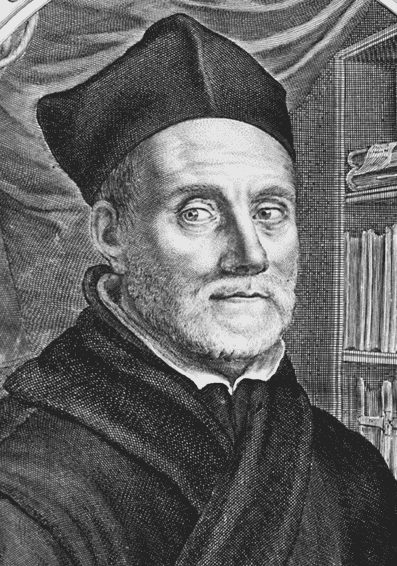
Today is the birthday of Athanasius Kircher (May 2, 1601/2 - November 28, 1680), polymath with an insatiable curiosity, oft referred to as the master of a hundred arts.

Athanasius Kircher was a scholar who studied in many different branches of knowledge and sought connections among them in a quest to recover ancient pansophia (universal wisdom). He knew Hebrew, Aramaic, Coptic, Persian, Latin, and Greek as well as various "modern" languages. He had a genuine thirst for knowledge, enthusiastically corresponding with scholars, princes, popes, and missionaries throughout the world.

Athanasius Kircher published over forty books on virtually every imaginable subject during his lifetime. His books were sought after and read in virtually every corner of the world.

Athanasius Kircher made a study of Egyptian hieroglyphs, to which he is considered one of the early pioneers and to some as the founder of Egyptology. He was one of the first to observe microbes through a microscope. During an outbreak of the plague, he suspected that the plague was caused by an infectious microorganism - one of the small animals he viewed under the microscope. He was ahead of his time with his "microscopic idea" and even his ideas regarding effective measures to prevent the spread of the disease, such as, burning clothes worn by the infected or wearing facemasks to prevent the inhalation of germs.

In the 1670s, Athanasius Kircher opened the Museum Kircherianum, one of the first public museums, in which he displayed much of his inventive playfulness. He made robot-like models, equipping them with speaking tubes so that an automaton would seem to greet visitors from another room by name and participate in conversations. He used the "magic lantern technology" to create an early slide projector. He built a box of mirrors that would create a cascade of optical illusions and hopelessly confuse an unfortunate cat that he would place inside the container. He also designed a cat piano (as a cat lover, I certainly hope it was never built/played).


Trivia bit: Athanasius Kircher is credited with inventing the first megaphone.

Kircher images source (1)
Cat piano image source (1)

Friday, May 1, 2009

Meandering about . . .

Today is the birthday of Santiago Ramón y Cajal (May 1, 1852 – October 17, 1934), physician, pathologist and Nobel laureate. He is oft referred to as one of the founders and/or godfathers of Modern Neuroscience.

"Like the entomologist in pursuit of brightly coloured butterflies, my attention hunted, in the flower garden of the gray matter, cells with delicate and elegant forms, the mysterious butterflies of the soul, the beating of whose wings may some day - who knows? - clarify the secret of mental life." - Santiago Ramón y Cajal

“The brain is a world consisting of a number of unexplored continents and great stretches of unknown territory.” - Santiago Ramón y Cajal

“As long as our brain is a mystery, the universe, the reflection of the structure of the brain will also be a mystery.” - Santiago Ramón y Cajal

Trivia bit: In 1905, he published five science-fictional Vacation Stories under the pen name Dr. Bacteria.

Stamp image source (1)