Thursday, May 14, 2009

Meandering to and fro . . .

Today is the birthday Herbert W. Franke (born May 14, 1927), author and scientist. He is active in the fields of future research, speleology, computer graphics, digital art and a highly respected science fiction author.

"I must not fear. Fear is the mind-killer. Fear is the little-death that brings total obliteration. I will face my fear. I will permit it to pass over me and through me. And when it has gone past I will turn the inner eye to see its path. Where the fear has gone there will be nothing. Only I will remain." - Herbert W. Franke

"No matter how exotic human civilization becomes, no matter the developments of life and society nor the complexity of the machine/human interface, there always comes interludes of lonely power when the course of humankind, the very future of humankind, depends upon the relatively simple actions of single individuals." - Herbert W. Franke

"Without change, something sleeps inside us, and seldom awakens. The sleeper must awaken." - Herbert W. Franke

"You should never be in the company of anyone with whom you would not want to die." - Herbert W. Franke

"Wealth is a tool of freedom, but the pursuit of wealth is the way to slavery." - Herbert W. Franke

"The beginning of knowledge is the discovery of something we do not understand. " - Herbert W. Franke

Trivia bit:  He received his doctorate in theoretical physics in 1950 by writing a dissertation about electron optics. 

Franke image source (1)

Wednesday, May 13, 2009

Meandering about . . .

Today is the birthday of Ole Worm (May 13, 1588 – August 31, 1655), also known as Olaus Wormius, physician  and polymath.

"Ole Worm's interests covered natural objects, human artifacts, mythical creatures, and ancient inscriptions. He had a special interest in runes, collected texts that were written in runic and wrote a number of treatises on runestones.

Ole Worm built one of the most well-known curiosity cabinets in Europe to house his collection.  After his death in 1655, his collection catalog, Museum Wormianum, or History of Rare Things was published. The catalog described one of the most well-known Wunderkammern or “wonder-rooms” of that period in Europe. 

He was the personal physician to King Christian IV of Denmark and remarkable for a physician of the time, he remained in the city of Copenhagen to tend the sick during an epidemic of the Black Death.

Trivia bit: The Wormian bones (small bones that fill gaps in the cranial sutures) are named after him.  He has been stated that he has as good a claim as anyone tothe title "The Father of Museums" due to his extensive collection and the cataloguing of it.

Ole Worm image source (1)

Tuesday, May 12, 2009

Today I go meandering . . .

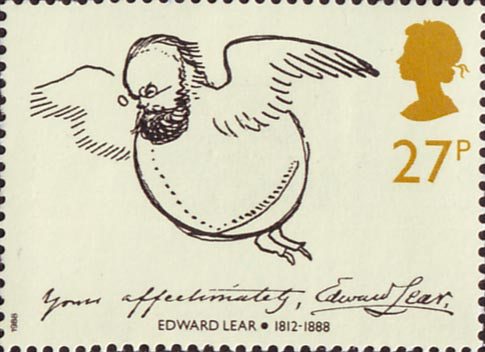
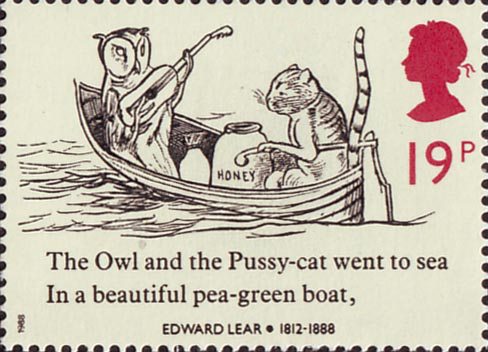
A Happy Birthday salute to Edward Lear (May 12/13, 1812 – January 29, 1888), artist, illustrator and writer known for his nonsensical poetry and his limericks. He was a highly-regarded nature and landscape artist, but is best-known for his poem The Owl and the Pussycat and popularizing the limerick.


"How pleasant to know Mr. Lear,
Who has written such volumes of stuff.
Some think him ill-tempered and queer,
But a few find him pleasant enough."
- Edward Lear


The Owl and the Pussy Cat went to sea
In a beautiful pea-green boat,
They took some honey, and plenty of money
Wrapped up in a five-pound note.
The Owl looked up to the stars above,
And sang to a small guitar,
"O lovely Pussy, O Pussy, my love,
What a beautiful Pussy you are,
You are,
You are!
What a beautiful Pussy you are!"
- Edward Lear

Trivia bit: "His birth certificate states that it was actually the 13th and Lear used the 13th May as his birthday in his diaries, however later in life he switched to the 12th." direct quote source (1)

*****

Today is the birthday of Jiddu Krishnamurti (May 12, 1895 – February 17, 1986), philosopher and writer. He has been referred to as one of the greatest philosophical minds of the 20th century.

Jiddu Krishnamurti was known for his passionate discourses on the various ways the human mind turns to self-delusion in its never-ending search for psychological fulfillment.

"The observer is the observed." - Jiddu Krishnamurti

"I think it is fairly clear why none of us do experience something beyond the mere watching. There may be rare moments of an emotional state in which we see, as it were, the clarity of the sky between clouds, but I do not mean anything of that kind. All such experiences are temporary and have very little significance. The questioner wants to know why, after these many years of watching, he hasn't found the deep waters. Why should he find them? Do you understand? You think that by watching your own thoughts you are going to get a reward: if you do this, you will get that. You are really not watching at all, because your mind is concerned with gaining a reward. You think that by watching, by being aware, you will be more loving, you will suffer less, be less irritable, get something beyond; so your watching is a process of buying. With this coin you are buying that, which means that your watching is a process of choice; therefore it isn't watching, it isn't attention. To watch is to observe without choice, to see yourself as you are without any movement of desire to change, which is an extremely arduous thing to do; but that doesn't mean that you are going to remain in your present state. You do not know what will happen if you see yourself as you are without wishing to bring about a change in that which you see. Do you understand?" - Jiddu Krishnamurti

"Man has throughout the ages been seeking something beyond himself, beyond material welfare—something we call truth or God or reality, a timeless state—something that cannot be disturbed by circumstances, by thought or by human corruption. Man has always asked the question: what is it all about? Has life any meaning at all? He sees the enormous confusion of life, the brutalities, the revolt, the wars, the endless divisions of religion, ideology and nationality, and with a sense of deep abiding frustration he asks, what is one to do, what is this thing we call living, is there anything beyond it?" - Jiddu Krishnamurti

"Truth is a pathless land." - Jiddu Krishnamurti

*****
Lear stamp image source (1)
Owl and Pussy Cat stamp source (
1)
Kishnamurti image source (1)

Monday, May 11, 2009

Forever meandering . . .

A Happy Birthday salute to Richard Feynman  (May 11, 1918 – February 15, 1988), physicist, oft referred to as the The Great Explainer.  He received the nickname due to his skill at making complex subjects understandable to the layman.

Richard Feynman has been credited with pioneering the field of quantum computing and introducing the concept of nanotechnology.

To those who do not know mathematics it is difficult to get across a real feeling as to the beauty, the deepest beauty, of nature ... If you want to learn about nature, to appreciate nature, it is necessary to understand the language that she speaks in." - Richard Feynman

"Our imagination is stretched to the utmost, not, as in fiction, to imagine things which are not really there, but just to comprehend those things which are there." - Richard Feynman

"Work hard to find something that fascinates you." - Richard Feynman

"The worthwhile problems are the ones you can really solve or help solve, the ones you can really contribute something to. ... No problem is too small or too trivial if we can really do something about it." - Richard Feynman

"The first principle is that you must not fool yourself -- and you are the easiest person to fool." - Richard Feynman


"Richard Phillips Feynman's life and work signify the joy of discovery and the pleasure of exploring things. He demonstrated that doing science could be fun. He provided an 'image of science that cut right across the stereotype'. He loved people more than he loved physics. He believed that the highest forms of understanding one can achieve are laughter and human compassion." direct quote source (1)

Trivia bit: Richard Feynman was a joint recipient of the Nobel Prize in Physics in 1965, together with Julian Schwinger and Sin-Itiro Tomonaga. He was also known as a prankster, juggler, a proud amateur painter, bongo player, an eccentric and a free spirit.

Feynman image source (1)
Feynman stamp image source (1)

Sunday, May 10, 2009

Here I go meandering . . .

Today is the birthday of Marcel Mauss (May 10, 1872 – February 10, 1950), sociologist and anthropologist. He is best known for his classic work The Gift, in which he states that gifts are never "free" and his other popular work, The General Theory of Magic.

He was fascinated with the nature of "the gift" and sought the answer to the question: "What power resides in the object given that causes its recipient to pay it back?"

"Work could be co-operatized, effective social security guaranteed and, gradually, a new ethos created whereby the only possible excuse for accumulating wealth was the ability to give it all away. The result: a society whose highest values would be "the joy of giving in public, the delight in generous artistic expenditure, the pleasure of hospitality in the public or private feast." - Marcel Mauss

“Any unusual interest in the sacred may bring about an accusation of magic” - Marcel Mauss

"Magic is a social phenomenon: public opinion creates the magician." - Marcel Mauss

"No gift is ever free." - Marcel Mauss

"In 'The Gift', Mauss (1924) explores gift-exchanges in various cultures and highlights the reciprocal nature of gifts and the obligation of the receiver to repay the debt. The object that is given carries the identity of the giver, and hence the recipient receives not only the gift but also the association of that object with the identity of the giver.

Mauss describes the Maori hau, which means the 'spirit of the gift'. The hau demands that the gift be returned to its owner. In Polynesia, failing to reciprocate means losing mana, the person's spiritual source of authority and wealth. Gift-giving is thus a critical mechanism for creating social bonds. Mauss describes three obligations:

Giving: the first step in building social relationships.
Receiving: accepting the social bond.
Reciprocating: demonstrating social integrity."

-direct quote source (1)

Trivia bit: Marcel Mauss stood up for the truth about Alfred Dreyfus and was very active in the events of the Dreyfus Affair.

Image source (1)

Saturday, May 9, 2009

Meandering to and fro . . .

Today is the birthday of James Matthew Barrie (May 9, 1860 – June 19, 1937), author and playwright. He is best known as J. M. Barrie, the creator of Peter Pan.

"Dreams do come true, if we only wish hard enough, You can have anything in life if you will sacrifice everything else for it." - J. M. Barrie

"If you have love you don't need to have anything else. If you don't have it it doesn't matter much what else you do have." - J. M. Barrie

"Nothing is really work unless you would rather be doing something else." - J. M. Barrie

"Those who bring sunshine into the lives of others cannot keep it from themselves." - J. M. Barrie

"Shall we make a new rule of life from tonight: always to try to be a little kinder than is necessary?" - J. M. Barrie

“It is not in doing what you like, but in liking what you do that is the secret of happiness” - J. M. Barrie

"Do you believe in fairies? Say quick that you believe. If you believe, clap your hands! " - J. M. Barrie

"I'm not young enough to know everything." - J. M. Barrie

Trivia bit: J. M. Barrie generously donated the copyright title to Peter Pan to the Great Ormond Street Hospital Children's Charity.

*****

Today is also the birthday of José Ortega y Gasset (May 9, 1883 - October 18, 1955), philosopher and essayist. He is best known for his influential work on social theory entitled, The Revolt of the Masses.

"We do not know what is happening to us, and this is precisely what is happening to us, not to know what is happening to us: the man of today is beginning to be disoriented with respect to himself, dépaysé, he is outside of his country, thrown into a new circumstance that is like a terra incognita." - Ortega y Gasset

“We live at a time when man believes himself fabulously capable of creation, but he does not know what to create.” - Ortega y Gasset

“The real magic wand is the child's own mind” - Ortega y Gasset

“Excellence means when a man or woman asks of himself more than others do.” - Ortega y Gasset

“We have need of history in its entirety, not to fall back into it, but to see if we can escape from it” - Ortega y Gasset

“We cannot put off living until we are ready.” - Ortega y Gasset

“Tell me to what you pay attention and I will tell you who you are” - Ortega y Gasset

“To be surprised, to wonder, is to begin to understand.” - Ortega y Gasset

*****

Barrie image source (1)
Ortega y Gasset image source (1)

Friday, May 8, 2009

Meandering about . . .

Today is the birthday of Sloan Wilson (May 8, 1920 – May 25, 2003), author. He is best known for his best-sellers The Man in the Gray Flannel Suit (1955) and A Summer Place(1958), both books were adapted to major motion pictures.

"The definition of a beautiful woman is one who loves me." - Sloan Wilson

"The hardest part of raising a child is teaching them to ride bicycles. A shaky child on a bicycle for the first time needs both support and freedom. The realization that this is what the child will always need can hit hard." - Sloan Wilson

"It's not a question of who's going to throw the first stone; it's a question of who's going to start building with it." - Sloan Wilson

"A man who wants time to read and write must let the grass grow long." - Sloan Wilson

Trivia bit:  His son is David Sloan Wilson is a Huffington Post blogger and author of several books.

Wilson image source (1)